.jpg&w=1920&q=75)

"Just something small" is one of the sentences I hear most often. It almost never refers to the size — it refers to the price, or to courage, or to both. The catch is that size is the one factor that genuinely changes a motif. A design that works on paper is not the same design in miniature at four centimetres. It is a different image.
What "small" actually means
Most people define small by feeling: discreet, quick to do, easy to hide. I calculate differently. What matters to me is not how many centimetres the motif has, but how many centimetres are left for each individual detail.
Two motifs of exactly five centimetres can be completely different pieces of work. One consists of seven lines, the other of seventy. The first will still read the same way in ten years. The second stops being a drawing the moment it has healed — it becomes a grey shape with a hint of form inside it.
My rough rule of thumb, before we even talk about the motif:
- Up to about 3 cm: a silhouette, a symbol, very few lines. No interior detail.
- 3 to 5 cm: a clear shape with a few internal lines — this is where most requests sit.
- 5 to 8 cm: real structure becomes possible, shading starts to make sense.
- From 8 cm: the motif is allowed to be complex without me having to sacrifice anything.
Why you cannot simply shrink a motif
This is where most conversations turn — and it is pure physics, not a matter of taste.
When you scale a drawing down on a screen, everything gets smaller: the shapes and the lines. On skin, only half of that happens. The motif gets smaller, the line does not. A needle has a fixed width, and it stays the same whether the motif is twelve centimetres or three.
Halve a motif and you double the visual weight of every line relative to the area. Two lines that sat two millimetres apart in the design now sit one millimetre apart, at unchanged line thickness. What were two lines on paper is one line on skin once it has healed.
Then there is time. Pigment does not stay exactly where it was placed over the years; it spreads a fraction. On a large piece nobody notices. At one millimetre of spacing, that fraction decides whether the drawing is still a drawing in five years. More on this in Tattoo Blowout — same mechanism, in its extreme form.
Spacing before detail — the rule I decide by
When I scale a design down, I do not count the details. I look at the clean skin between them.
My working rule: anything with less than roughly one millimetre of spacing when freshly tattooed, I treat as a single line — because that is what it becomes. This rule is uncomfortable, because it almost always means something has to leave the design. It is also the only reason my small pieces still read as what they were meant to be years later.
I work exclusively in black and grey and almost entirely in fine line. Which means I cannot rescue a cramped detail with a change of colour. Either it has room, or it goes.
What I remove from a design as it gets smaller
Almost always in this order:
- Interior detail that only repeats the shape — leaf veins, feather structure, fur strokes.
- Double contours. A line running alongside another is the first thing to merge.
- Hatching and fine shading on a small surface. A gradient turns into a blotch.
- Lettering below a certain height. Letters live on the gaps inside them, and script loses those first. Why lettering is a discipline of its own is covered in Lettering Tattoo.
- Anything meant to create perspective. Depth needs surface.
What remains is usually less than the client had pictured — and in almost every case the better tattoo.
Silhouette beats detail
Whether a motif works small comes down to one test: can you still recognise it from the outline alone?
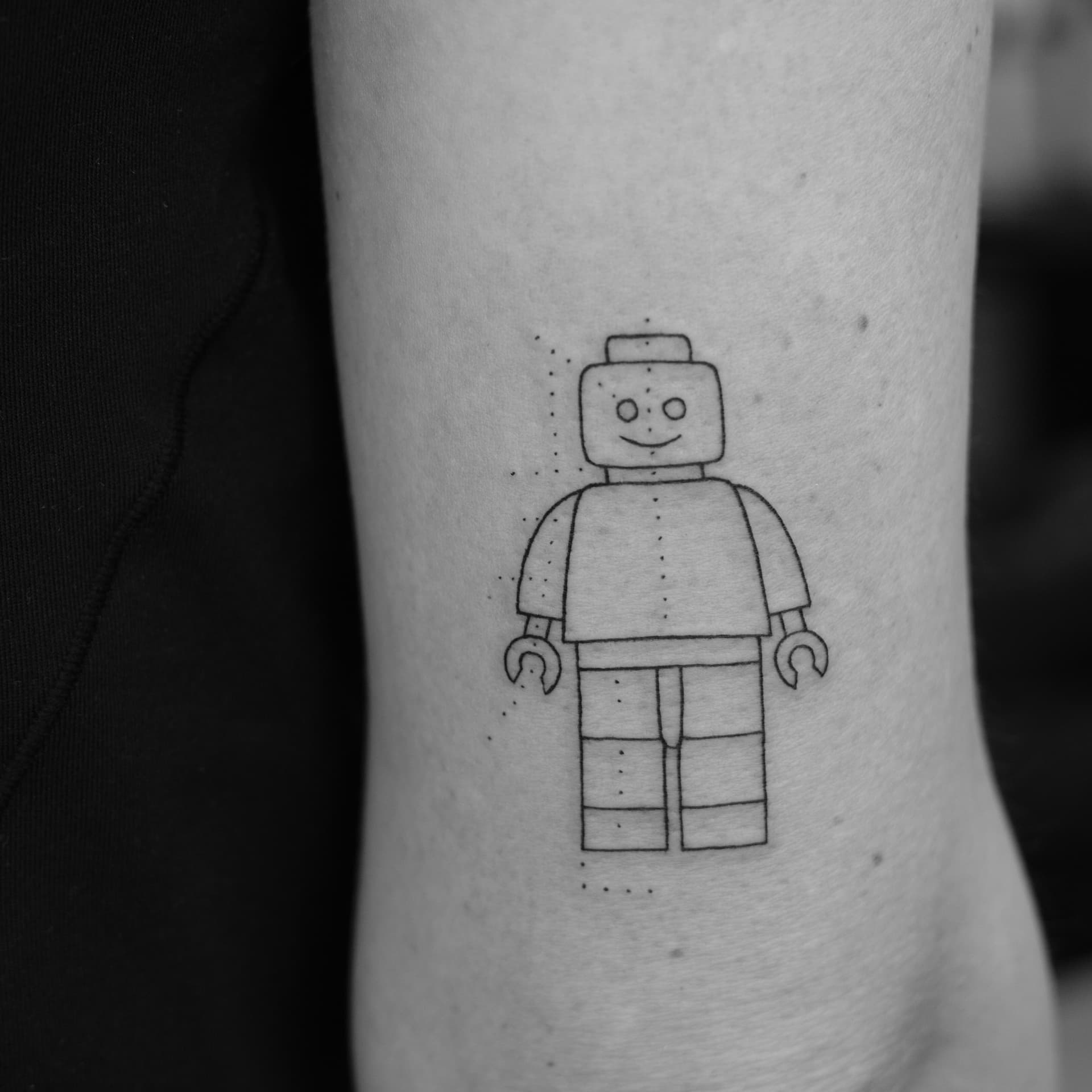
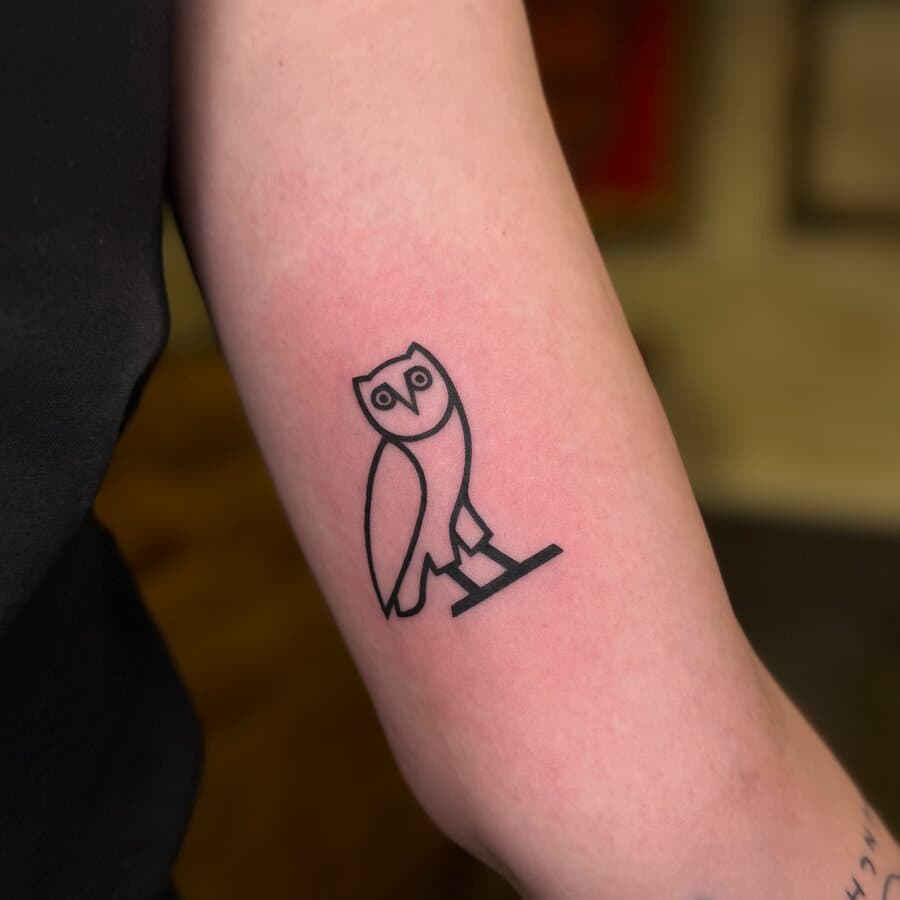
Motifs that pass that test handle small formats well — a crescent moon, a single branch, a basic geometric shape, a wave, a key. Their identity sits in the outer form. Take the interior away and they are still themselves.
Motifs that fail are recognised only by their interior: a face, a whole scene, a clockwork, a building with windows. Shrink them and you remove exactly what makes them recognisable. What is left is a shape that could be anything.
That, incidentally, is why I ask about the motif first and about the size second — not the other way round. The reverse order almost always produces a compromise nobody wanted. How I work through that is in The first consultation.
Small does not mean fast, and it does not mean cheap
This is the sentence that causes the most disappointment. A small tattoo is rarely proportionally cheaper, for two sober reasons.
First: a large share of the work does not depend on size at all. Consultation, design, stencil, preparing the area, hygiene — that is nearly identical at three centimetres and at twelve.
Second: per square centimetre, small is slower, not faster. On a small surface nothing is forgiving. On a large composition half a millimetre of deviation disappears into the whole. On a three-centimetre motif, half a millimetre is a visible mistake.
What an appointment with me actually costs is on the pricing page — the conditions there are current and complete, which is why I am not quoting numbers here that might not hold tomorrow.
What is left after five years
A well-planned small tattoo does not age worse than a large one. An overloaded small tattoo ages considerably worse — not because it is small, but because it never had any spacing to begin with. How that process works in general is in How tattoos age, and which placements accelerate it is in Tattoo Placement and Tattoo problem areas.
If a fine spot on one of my pieces does not sit right after healing: the first touch-up within roughly three weeks of healing is free with me. What is normal and what is not is covered in Tattoo touch-ups.
Frequently asked questions about small tattoos
How small can a tattoo be?
There is no fixed lower limit in centimetres — what decides it is the ratio of area to detail. A symbol made of a few lines works well under three centimetres. A motif with interior detail generally needs at least five, otherwise the lines merge as it heals.
Do small tattoos blur over time?
Small tattoos do not blur because they are small, but because there is too little space between their lines. Pigment spreads a fraction over the years. Where there was one millimetre of spacing to begin with, that eventually becomes a single line; where there were two, the drawing stays readable.
Which motifs suit small tattoos?
Motifs you recognise by their outline: geometric shapes, a single branch, a crescent moon, a symbol. Unsuitable are motifs whose recognition depends on interior drawing — faces, scenes, technical detail such as clockwork.
Is a small tattoo cheaper?
Usually yes, but not in proportion to the size. Consultation, design, stencil and preparation apply regardless of size, and on a small surface precise work is slower per square centimetre than on a large one.
Does a small tattoo hurt less?
It takes less time, but the intensity depends on the placement, not on the size. A three-centimetre motif on the ribs is more unpleasant than a ten-centimetre one on the upper arm. More on that in Tattoo pain.
If you have an idea and are not sure whether it works at the size you have in mind, bring it before you commit to the size. In most cases we find a version that stays small and is still a drawing. Just write to me.