.jpg&w=1920&q=75)

Most people fall in love with the design first and only start thinking about placement afterward. That is exactly where placement gets underestimated. But the area of the body does not only affect how the tattoo looks on day one. It also shapes how it heals, how it moves with you, and how well it holds up over time.
A tattoo does not exist on paper. It exists on the body. And the body is never just a flat surface. Every area has its own tension, shape, movement, texture, and level of daily stress. Some places give a design calm, balance, and clarity. Others challenge it with motion, friction, or more demanding healing. That is why I never see placement as a last-minute choice. For me, it is part of the design from the start.
Placement is not an afterthought
A strong tattoo is not only about a strong image. It is about the relationship between the image and the body. Good placement begins right there. It is not about finding any empty space for a design. It is about choosing the place where the tattoo actually makes sense.
Some tattoos need open space to breathe. Others need direction along the arm, the leg, the ribs, or the back. Some work best when they follow the anatomy and feel naturally connected to it. If placement is treated as a detail at the very end, even a beautiful design can feel disconnected. If it is considered from the beginning, the result feels more natural, more intentional, and much stronger.
How the body shapes a tattoo
A lot of people imagine a tattoo as a fixed image under the skin. In reality, it lives with your body. Skin is different everywhere. It changes in thickness, texture, tension, moisture, and how much stress it takes in everyday life. Then there is sun exposure, exercise, clothing, sleep position, work, and each person's individual healing process.
That is why tattoos age differently depending on the area. A calm, stable zone may keep fine details readable for a long time. A heavily used zone may change faster. That does not mean certain placements are automatically bad. It simply means they come with different expectations. Honest consultation matters more than a fast yes to a spontaneous idea.
Where fineline really works
Fineline looks light, precise, and elegant — and that is exactly why placement matters so much. Fine lines need calm. They tend to work best on areas where the skin is relatively stable and not under constant heavy stress.
That is why fineline often works beautifully on the forearm, upper arm, shoulder blade, thigh, or ribs, depending on the design and the client's anatomy. It becomes more difficult on areas exposed to constant friction, moisture, or repetitive movement. Especially with very small tattoos, that difference matters. What looks beautifully delicate on a stable area can lose sharpness much faster on a more demanding one.
If this style speaks to you, you can explore more here: Fineline Tattoo Munich.
Where Japanese motifs can breathe
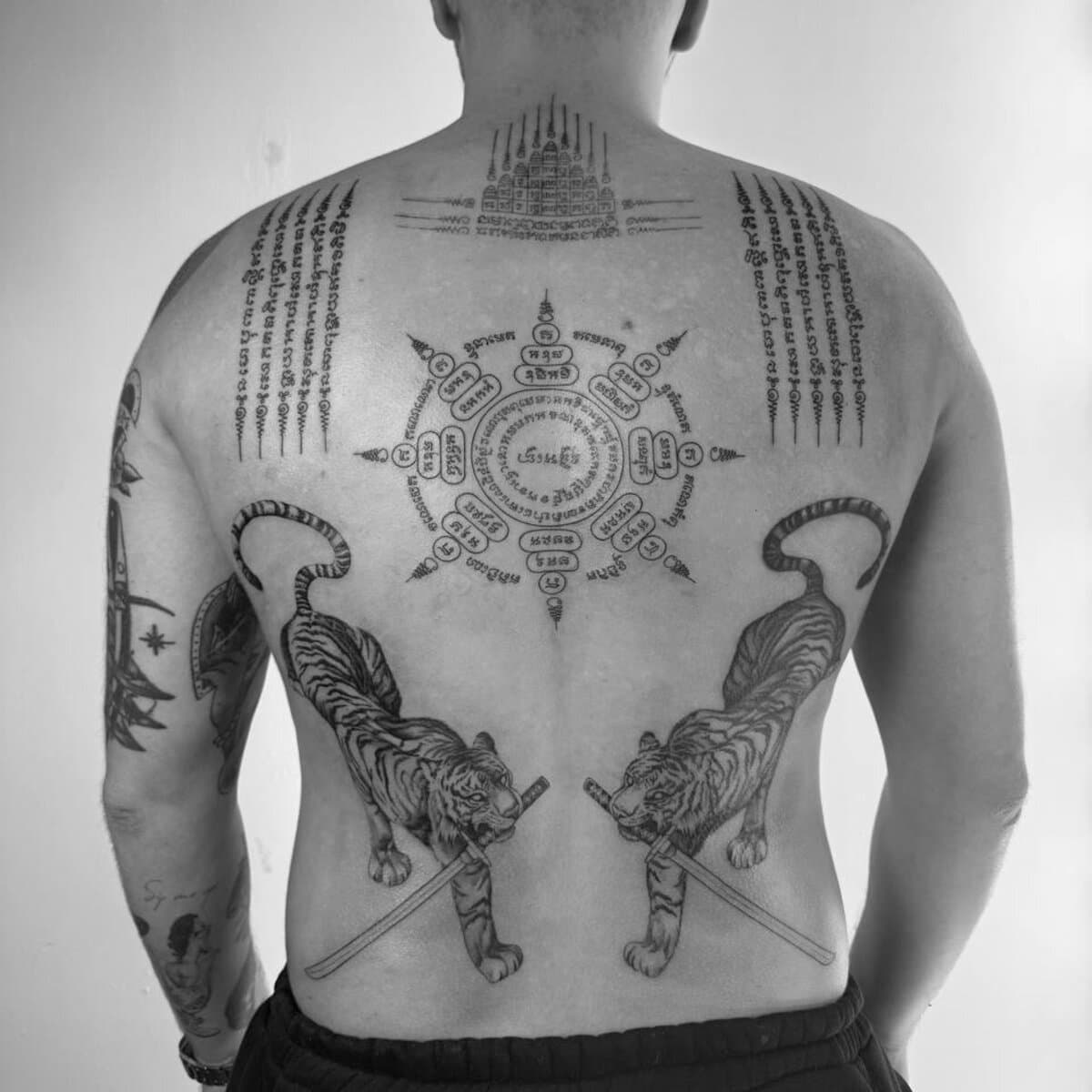
Japanese tattooing usually asks for more than a good drawing. It needs composition, direction, movement, and space. The back, chest, shoulder, side body, or leg can give these motifs a completely different level of presence than smaller isolated placements.
In Japanese work especially, the flow of the body matters. The tattoo should not feel like an image placed on top of the skin. It should move with the muscles, curves, and transitions of the body. That is what creates power and rhythm. That is what gives the work room to breathe. In this style, placement is not only technical — it becomes part of the visual language itself.
You can see more of this approach here: Japanese Tattoo Munich.
Areas that tend to age faster
Some body areas are simply more demanding than others. Fingers, hands, palms, feet, the neck, and mucosal areas are common examples. The reason is simple: these zones deal with more movement, more irritation, and more wear in daily life.
Hands and fingers are constantly exposed to friction, water, and repeated use. Tattoos there often heal less evenly and may fade or spread faster over time. Mucosal tattoos are an even more specific case, because that tissue behaves very differently from regular skin and often does not hold pigment in a stable way for long.
That does not mean these placements should never be done. It just means they require more experience, more honest expectations, and a very clear understanding of the trade-offs.
Visibility or intimacy?
Placement is not only technical. It is also deeply personal. Some people want to see their tattoo every day. Others prefer it to remain more private and only appear in certain moments. For some, work matters. For others, it is more about emotional comfort, personal symbolism, or how close the tattoo feels to their inner world.
A tattoo on the forearm has a very different presence from one on the ribs, the back, or the thigh. It says something different. It lives with you differently. That is why I do not only ask what looks good. I also ask how you want to live with this tattoo.
What I ask before discussing placement
Before I recommend an area, I want to understand who you are and how you move through everyday life. For example, I may ask:
- Do you want your tattoo to be visible every day or more private?
- Are you looking for something subtle and quiet, or something with stronger presence?
- How important is long-term clarity in very small details?
- How much stress does that area take from training, work, or clothing?
- Do you want the design to flow with the body or sit like a clear statement?
A good tattoo does not begin only with a strong idea. It begins with the right place for that idea to live. Placement is never a side detail. It is part of the design — and often the difference between a tattoo that simply looks nice and one that truly belongs on the body. For pricing per placement and style, see the Tattoo Prices Munich page.