.jpg&w=1920&q=75)

Hot topic. Genuinely.
Over my years working as a tattoo artist in Munich, I've heard it countless times: "someone stole my design", "they took my idea", "my work was copied". And I've seen the same fear in colleagues' eyes when a client shows their phone and says: "I want exactly this, don't change a thing."
So what do we do with that? Let's talk honestly.
Wanting a Tattoo "Like Someone Else's" — That's Normal
If you come in with a reference and say "I want exactly this" — no problem. There's no shame in asking. I'll always try to suggest something, bring in something personal, adapt it to your body. But if the answer is "no, exactly like this" — it's your body and your choice.
Wanting a tattoo like your friend's, like a stranger on the street, like your favourite influencer — completely normal. It doesn't mean you have no taste. It means something caught your eye and you want it on your skin. Nothing more honest than that.
And for what it's worth: if I've done a piece based on someone else's reference and I know who the original artist is — I'll tag them. I think they'd appreciate it. I would.
Copying Is the Foundation of All Art
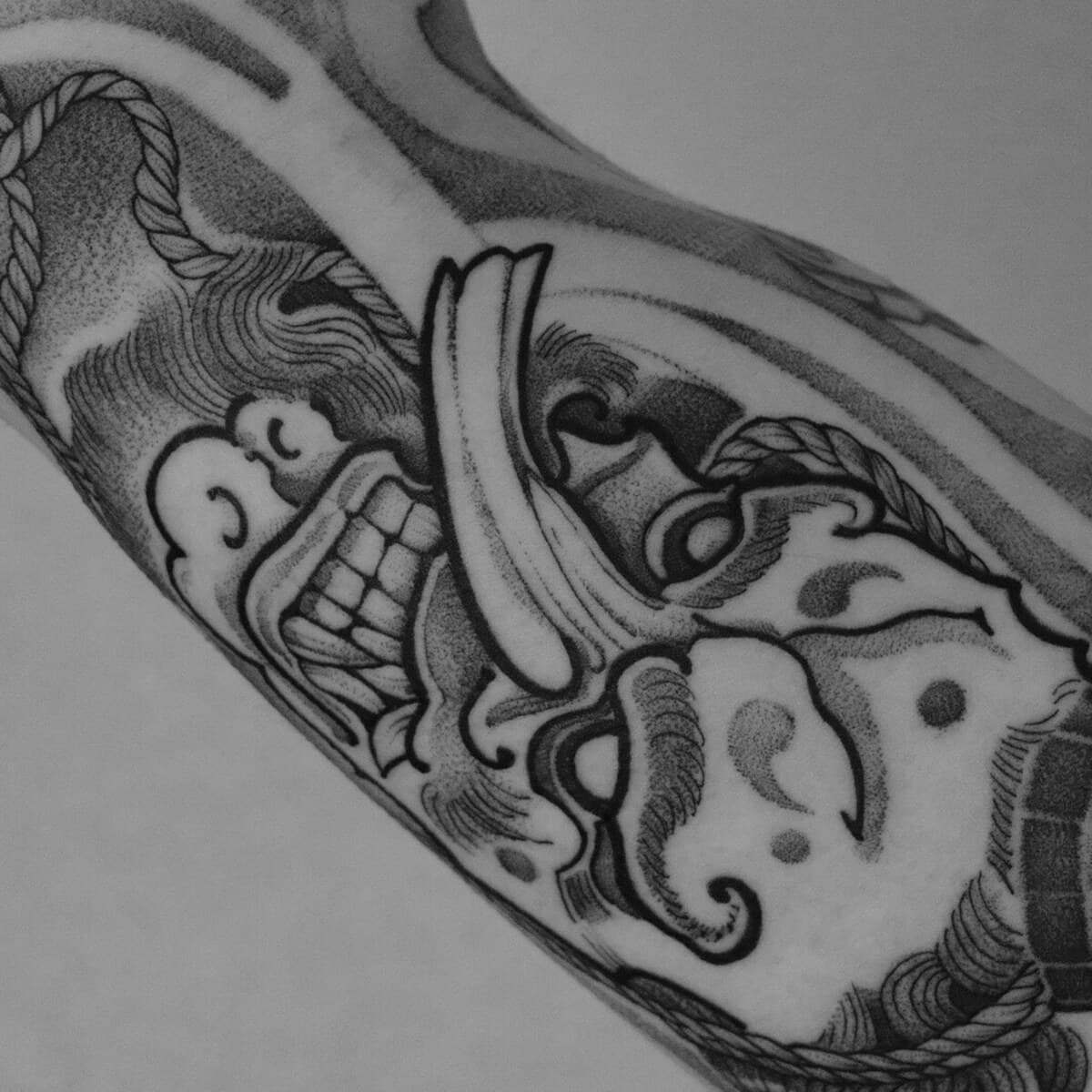
Philosophically speaking: copying is what lets us not start from scratch every single time. I copy every day. Transferring a stencil onto skin — that's copying. Taking inspiration from leaves on the street, from architecture, from other artists' work — and reworking it in my own way.
That's how all art works. Nobody says musicians steal notes from each other. Our entire style is a synthesis of what we love about others, reworked in our own voice. Japanese tradition, tribal, old school — all of it was made from the same templates for centuries.
Here's the Real Line
Good copying is inspiration, reference, working in someone's style. That's normal and honest.
Bad copying is one specific thing: when an artist takes someone else's finished work, presents it as their own, and charges money for it. Claiming someone else's labour. It's happened to me. I saw my own work in another artist's account — with their signature, their pricing. Uncomfortable? Yes. But more than anger, I felt surprise. Do they really have no ideas of their own? That's a question for the person, not the industry.
The difference is simple: got inspired and made something new — that's growth. Copied and called it yours — that's fraud. Mostly towards the client.
If You're Coming In With a Reference — Here's How to Make the Conversation Easy
Just say it honestly: "I love this, I want something like it." You don't need to justify yourself or prove you're original. A good artist won't judge you — they'll ask what specifically caught your eye about that piece. The line work? The mood? The placement? That conversation is exactly where your tattoo comes from. Even when it starts with someone else's photo.
A Story I Won't Forget
A client came in one day. He said he wanted a tribal sleeve. Had dreamed about it since the 90s — finally time to do it.
I was stunned. Tribals have been out of fashion for a long time. I tried everything to talk him out of it. Honestly? Pointless. He wanted exactly that. The thing that had lived in his head for twenty years.
Was he happy at the end? One hundred percent. Not "okay", not "I like it" — actual happiness. And that's when I understood: my job isn't to police tattoo trends. My job is to make sure a person leaves with what they actually wanted.
Every Tattoo Is Unique — Even If the Design Is the Same
Give the same design to ten artists — you'll get ten different pieces. Everyone has their own hand, their own pressure, their own history. Plus your skin, your body, your context.
And besides — in a year, in five years, that tattoo will be completely yours. It heals in, settles in, gathers memories. Nobody else wears it the way you do. That's when the question "is this original?" simply disappears.
So go ahead — sleeve, shoulder, back — however you want it most. In 99% of cases the concept exists somewhere already. But your tattoo? That doesn't.
Got questions about your idea or want to bring in a reference? Come to a consultation. No judgment — just a real conversation. Looking for inspiration? Browse my finished work — every piece started as an idea we developed together.