.jpg&w=1920&q=75)

I see them regularly in my work: people who hide their arm when they take off their jacket. Who haven't been to the beach in years. One client told me she spent three years turning down every invitation to the water — because of a tattoo on her leg she got at twenty and immediately regretted.
A cover-up can change that. But not always. And I'd rather tell you now — before you book a consultation.
What a Cover-Up Really Is
A cover-up isn't "painting over." It's not about hiding the old tattoo — that's not how it works. It's about developing a completely new design that's visually stronger than what's already in the skin. The new design has to be darker, higher contrast, and almost always larger than the original. The old work doesn't disappear — it becomes part of the new piece.
Which Tattoos Work for a Cover-Up
The best candidates: light, faded work — fineline, lettering, small designs without thick black outlines. The older and lighter the tattoo, the more room I have to work with in the design.
What gives me room to work: a 5-year-old fineline tattoo that's faded a bit. What pushes me to my limits: massive black fill. Thick solid areas. Bad corrections where an inexperienced artist tried to "fix" their own work — and made everything even darker in the process.
When I Say No — and Why That's Okay
Statistically, I take about 20% of all cover-up requests. That sounds low. But I don't want to do work that won't turn out the way I envision it — or the way you envision it.
A tattoo done 20 years ago that's completely black leaves me very little room for a cover-up. I can say honestly: "No, I won't do this" — because a no here is better than a result you'll be unhappy with again.
When Laser Helps
For difficult cases, I sometimes recommend a few laser sessions first. Not to completely remove the old tattoo — that almost never happens in practice. But to lighten it. Two or three sessions can significantly increase the design options. It costs time and money — but it's the difference between a cover-up that works and one that just creates another problem.
My Top Style for Cover-Ups: Realism
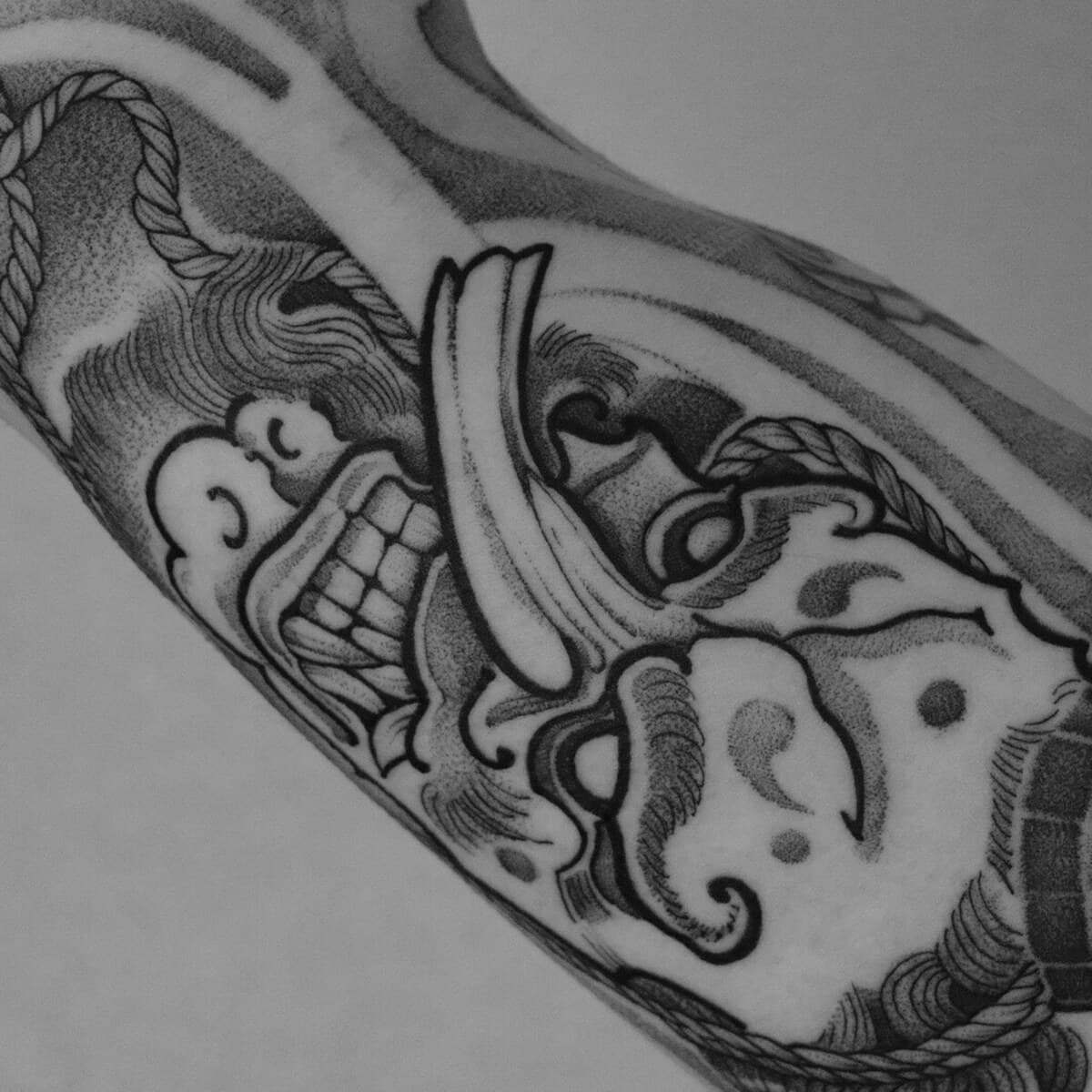
When I have free choice, realism and graphic tattoo is my favourite style for cover-ups. Why? Because a realistic design — an animal, a portrait, a botanical illustration — doesn't just allow for a complex background, it needs one. The old work becomes part of the texture, the shadow, the depth effect. It doesn't disappear — it becomes invisible.
What Happens at the Consultation
I only take on cover-ups after a personal consultation. I need to see the tattoo with my own eyes — photos lie. Light, depth, scar tissue, skin tone: I make all of these decisions only when the work is right in front of me.
Scars under an old tattoo, for example, change everything. The ink sits differently, the healing goes differently, the result looks different. These are things I can't see in a photo.
A Bad Tattoo Is Not a Life Sentence
Most importantly: a bad tattoo doesn't mean you have to live with it forever. It means you need the right artist, the right approach — and realistic expectations.
Sometimes the answer is laser plus cover-up. Sometimes it's a new design strong enough to overpower the old one. And sometimes the most honest answer is: let's wait one more year and do it right.
Come to the consultation. We'll look together at what's possible.