.jpg&w=1920&q=75)

Why a Japanese Sleeve Is Its Own Category
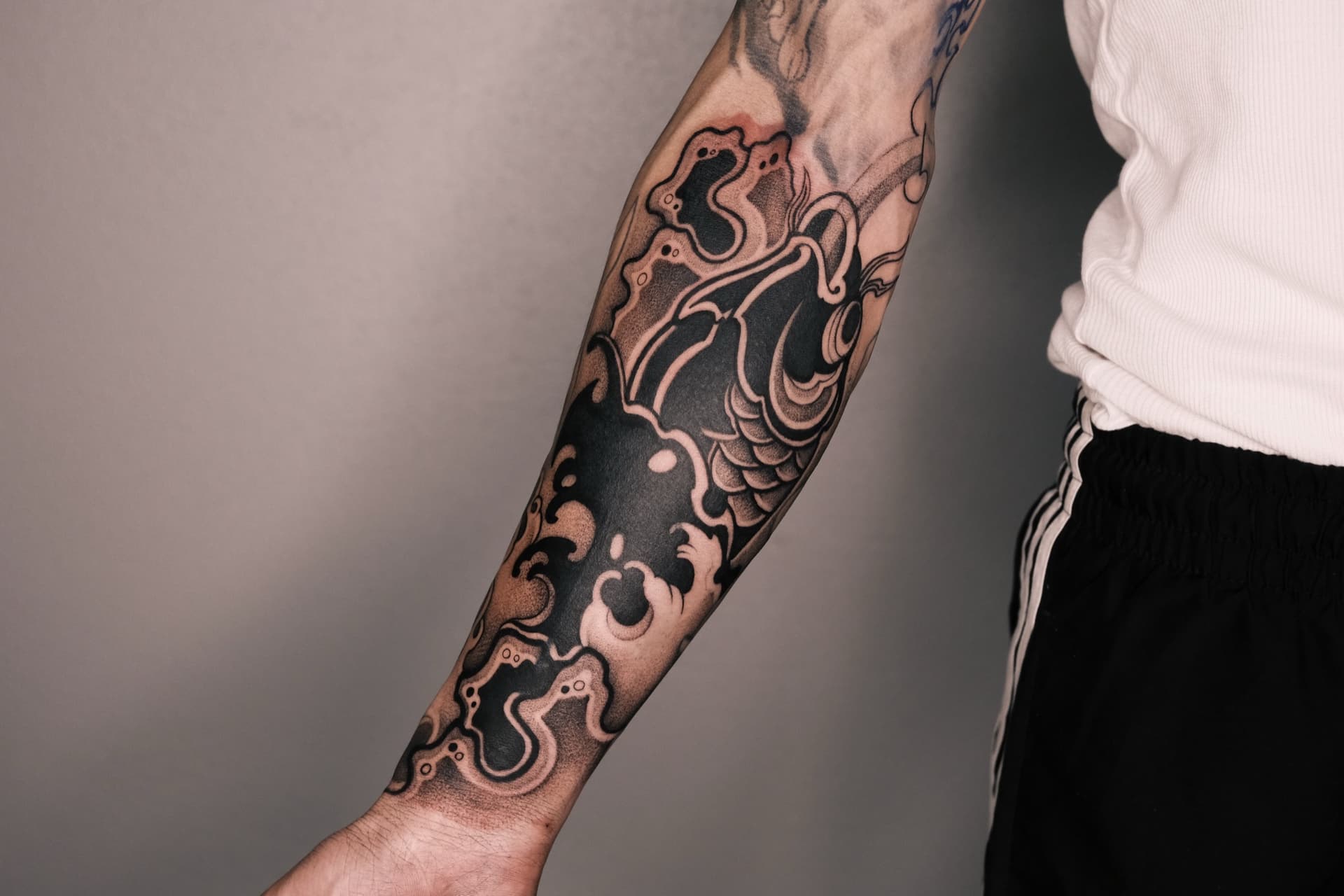
Today I want to talk about my favourite style — and honestly, one of my favourite projects to work on: the Japanese sleeve tattoo in the tradition of irezumi.
You may have already guessed from the title, but I want to make it clear: I'm specifically talking about sleeves. A natural question — why just sleeves, when Japanese tattoos in general are already quite popular?
The answer is simple: the Japanese sleeve is its own niche within the style.
It's a complex, large-scale project that demands a high level of craft — especially when we're talking about a quality Japanese tattoo in Munich, not just a decorative piece.
And that raises the question: what does "done right" actually mean?
First of all, it comes down to anatomy. Every person's arm is shaped differently, and the sleeve doesn't just get laid on top — it should follow the body, accentuate it, and work with it.
That's the whole point of traditional Japanese tattooing (irezumi) — not to cover the person, but to amplify them visually.
That's why this article is for anyone thinking about a big project and looking for a Japanese tattoo artist in Munich. This is exactly what I can help with.
Who a Japanese Sleeve Is Really For
Let's figure out who a Japanese sleeve actually suits.
The key thing to understand: a sleeve isn't one big image. It's a story told across the arm that "reads" over time — like a proper Japanese sleeve tattoo.
My favourite approach is when the second arm carries either the continuation of that story or its counterpart. Then the whole body becomes a single canvas.
Work like this stays with you for decades and carries a certain philosophy.
That's why a Japanese sleeve is always about meaning — not just visuals.
Which naturally leads to the next question: where does that story come from, and how do you build it?
Over the years I've collected rare literature on irezumi and Japanese tattooing — some books were brought over from Japan by clients, others I tracked down myself.
Here's how the process works:
We choose the main figure together — this could be a dragon, tiger, koi carp, kitsune, or other Japanese motifs.
Then I build the whole narrative around it. Japanese culture has thousands of symbols, and each carries its own meaning.
My job is to connect them into a single cohesive story that truly reflects who you are.
After that I create the design. This usually takes between three days and a week — every Japanese sleeve is one of a kind.
Even if two people choose the same main character, their sleeves will end up completely different — because each one is built from that person's character and their story.
How Many Sessions a Japanese Sleeve Really Takes
Once the concept and narrative are clear, the next natural question is: what does the process look like, and how long does it take?
Let me break it down simply.
First, a consultation — usually one to two hours. If you're looking for a tattoo studio in Munich for a major project, this is the most important step.
Then I develop the sketch. That takes three to seven days on average.
After that, the sessions begin. The number depends on the design, but a Japanese sleeve tattoo typically runs around four to five sessions.
Important to understand: a project like this can't be done in one sitting without losing quality. That's the foundation of any serious irezumi — the work happens in stages.
On average, a Japanese tattoo sleeve in Munich comes to somewhere between €2,000 and €3,500.
As for the overall timeline: a sleeve is typically finished in roughly half a year. After each session the skin needs time to recover — usually two to three weeks.
This isn't a fast process. It's considered work, where every stage matters.
What It Costs — and How Pricing Works
There's no fixed price for a Japanese sleeve tattoo.
The cost depends on many factors: size, complexity of the narrative, density of detail, colour or black and grey, and total volume of work.
That's why most tattoo studios in Munich charge per session for these projects.
It's a fair format — you pay for real work.
A good Japanese sleeve isn't a one-off purchase. It's an investment in something that will be with you for years.
How to Prepare for Long Sessions
Preparation matters before long sessions. Nothing complicated — but it directly affects how the process goes and how a Japanese tattoo heals:
- proper sleep
- eat before the session
- stay hydrated
- no alcohol
And the main thing: you don't need to push through the pain. Breaks are a normal part of the work.
From First Consultation to Finished Sleeve
The typical process looks like this.
You write to me or leave an enquiry. Usually these are people who've already been searching for Japanese tattoo Munich and want to commit to a large project.
Then comes the consultation. We talk through the idea, motifs, and general direction.
After that, the work begins.
Sessions progress in stages: outline first, then large forms, then detail work. Midway through, the sleeve can look unfinished — that's completely normal for any Japanese sleeve.
The final result: fully healed work and a cohesive whole.
What You're Really Committing To
This is where honesty matters.
A Japanese sleeve takes time. Several months on average, sometimes longer.
It's a process. There will be a stage when the work looks "unfinished" and that can feel unsettling — but it's part of the journey.
And it changes how you see yourself. A tattoo like this shifts how you perceive yourself and how others see you.
Ready to Start?
If you've been thinking about a Japanese sleeve tattoo and are looking for a tattoo artist in Munich — write to me or book a consultation.
We'll go through your idea calmly, choose the motifs, and talk through sessions and budget. Learn more about my approach to Japanese Tattoo Munich on the style page.