
When someone asks me about a Japanese motif, it is almost never about the picture. It is about what it means — and that is exactly where the misunderstandings start. In the West the dragon is a monster; in Japan it is a protector. The geisha gets read as a courtesan, when she was a musician and a dancer.
I did not learn this symbolism from picture books but from Japanese literature. So here is what these figures actually carry — and at the end, which of them I deliberately do not tattoo.
The Japanese Dragon (Ryū) — Wisdom, Not Malice
What does a Japanese dragon tattoo mean?
The Japanese dragon stands for wisdom, protection and a strength that needs no proof. It is not a fire-breather like the European dragon but a creature of water: it brings rain, it protects, it has known the world far longer than you have. Wearing a Ryū does not say "I am dangerous". It says "I have understood something".
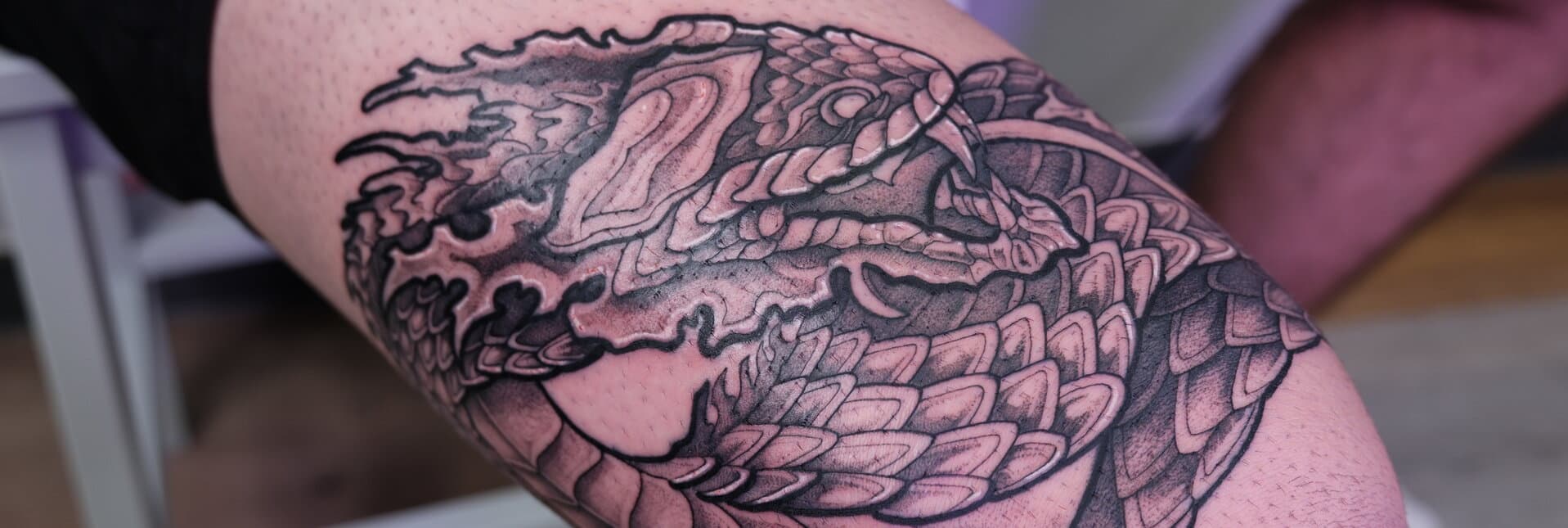
A detail almost nobody knows: the Japanese dragon has three claws, the Chinese one five, the Korean one four. If you find a reference on Pinterest, count the claws — that tells you which tradition the motif actually comes from.
What is the difference between a rising and a descending dragon?
The direction changes the statement completely:
- Nobori Ryū, the rising dragon — ambition, a goal still ahead of you.
- Kudari Ryū, the descending dragon — strength that is already there and has nothing left to prove. It comes down to protect.
- Dragon with a pearl (Tama) — wisdom being held; the pearl is the knowledge itself.
- Dragon and tiger together — the classic pairing: sky against earth, calm against instinct.
For me that is the first question in the sketch, before size: is it rising or descending? The whole composition follows from the answer.
Samurai — Bushidō, Not Combat
What does a samurai tattoo mean?
A samurai tattoo stands for a code, not for violence. Bushidō, "the way of the warrior", describes a stance: justice (gi), courage (yū), compassion (jin), sincerity (makoto), honour (meiyo), loyalty (chūgi). The fighting is secondary in these motifs. What matters is that someone holds to rules even when they get expensive.
That is also why a samurai rarely works small. The armour lives on lamellae, knots and cords — strip the detail and you are left with a silhouette in a helmet.
What is the difference between a samurai and a rōnin?
A rōnin is a samurai without a master: same training, same stance, but nobody to serve. As a tattoo that is a very different statement — not loyalty but independence, often after a break in someone's life. When a client hesitates between the two, they usually mean the rōnin.
Geisha — The Figure Most Often Misread
What does a geisha tattoo mean?
A geisha stands for craft and discipline. "Gei" means art, "sha" means person: geisha are musicians, dancers and conversationalists with years of training behind them. A geisha tattoo means skill that was earned, and grace that was work.
The mistake I see most often: references that actually show an oiran, a courtesan. You can read the difference from the obi — a geisha ties it at the back, an oiran at the front — and from the many hairpins. If what the figure says matters to you, that is not a minor detail.
Tora, the Tiger — Courage That Protects
In irezumi the tiger is a guardian: it keeps illness, misfortune and evil spirits away. It belongs to the wind, which puts it in direct tension with the dragon, who belongs to the water. That is why you see the two together so often — not as a fight, but as a balance.
Which Japanese Motifs I Do Not Tattoo
Which Japanese symbols should you not get tattooed?
I will tell you straight, before you spend three months on an idea:
- Full-body compositions in the classic yakuza layout. In Japan they will get you turned away from onsen, gyms and some hotels. That is not theory, it is house policy.
- The Kyokujitsu-ki, the rising sun rays. In Korea and China it is politically loaded like almost no other symbol.
- Kanji you cannot read. I do not translate "by feel". If I cannot verify the characters myself, I will not tattoo them.
- Motifs from another tradition sold as Japanese. Five claws is a Chinese dragon. That is not worse — it is simply not what you ordered.
Why I Tattoo These Figures in Black and Grey
Does a Japanese tattoo work without colour?
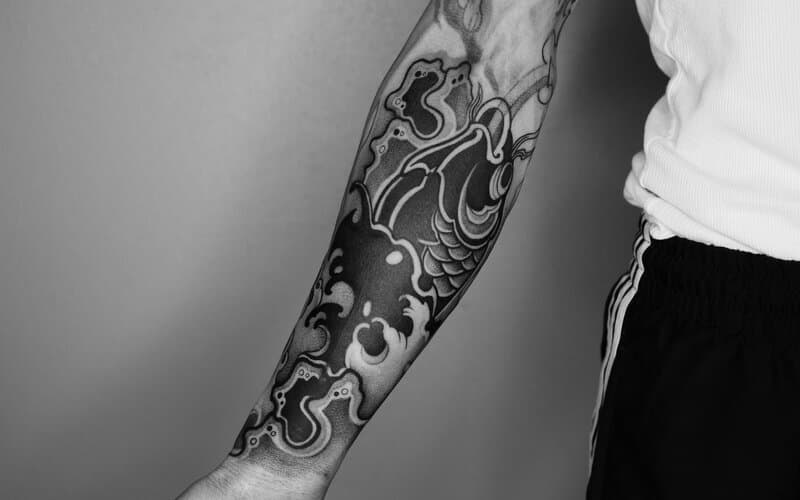
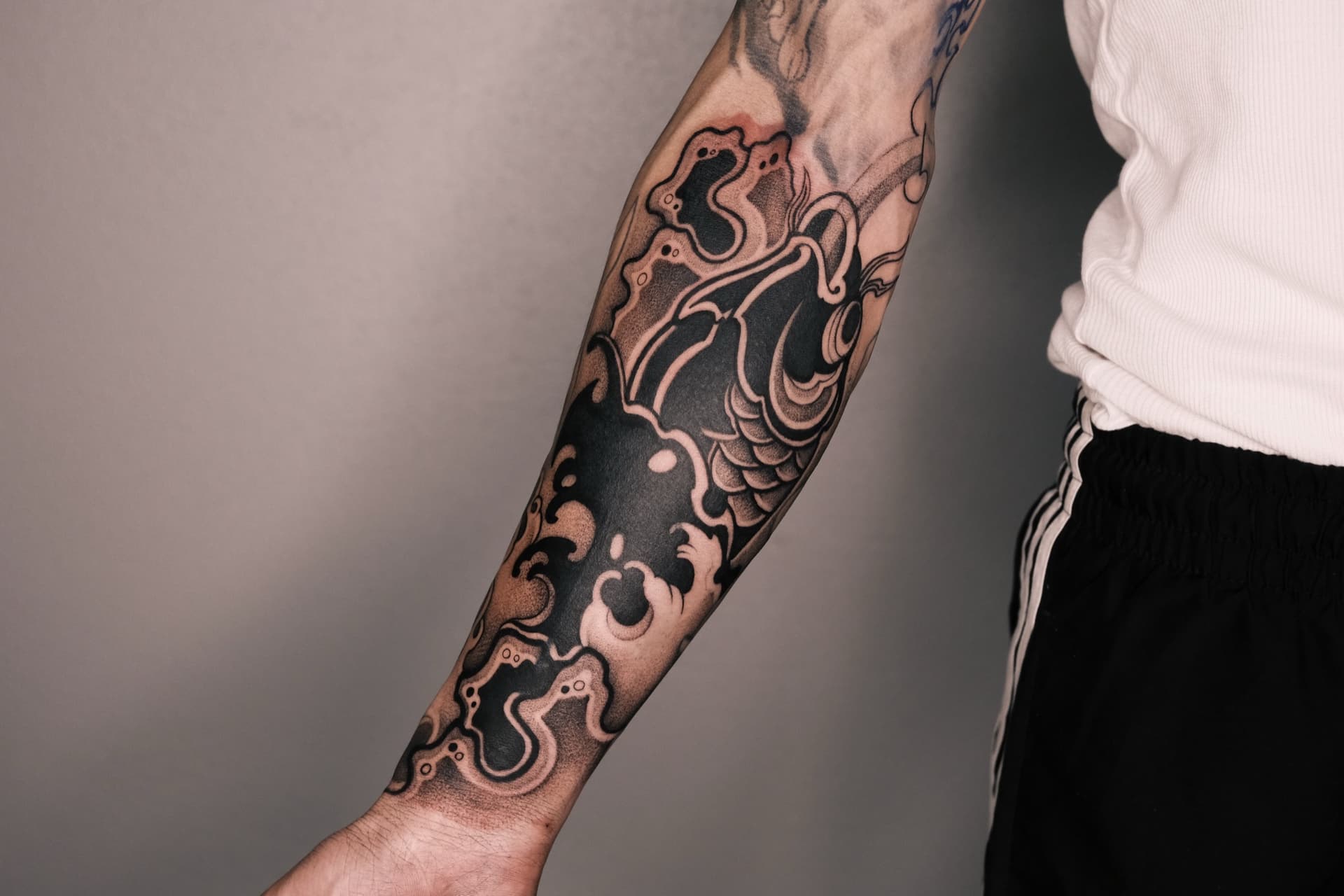
Yes — and in my case it is the more honest answer. I work exclusively in black and grey, built up in a modern, graphic way rather than as traditional colour irezumi. The foundation of any Japanese tattoo is sumi black anyway: outline and shading carry the whole figure, and colour historically came on top.
A dragon in black and grey loses nothing in meaning. It loses the colour symbolism — and the argument about whether red still looks like that in twelve years.
What Separates Real Irezumi from "Japanese-Inspired"
Real irezumi has strong outlines, deep shadows and respect for composition: the balance between filled and empty, between figure and background. Waves, wind and clouds are not decoration, they lead the eye.
What I often see sold as "Japanese style" is weak linework and a figure floating in nothing. That is a picture with a Japanese motif — not irezumi.
Where These Figures Sit Best
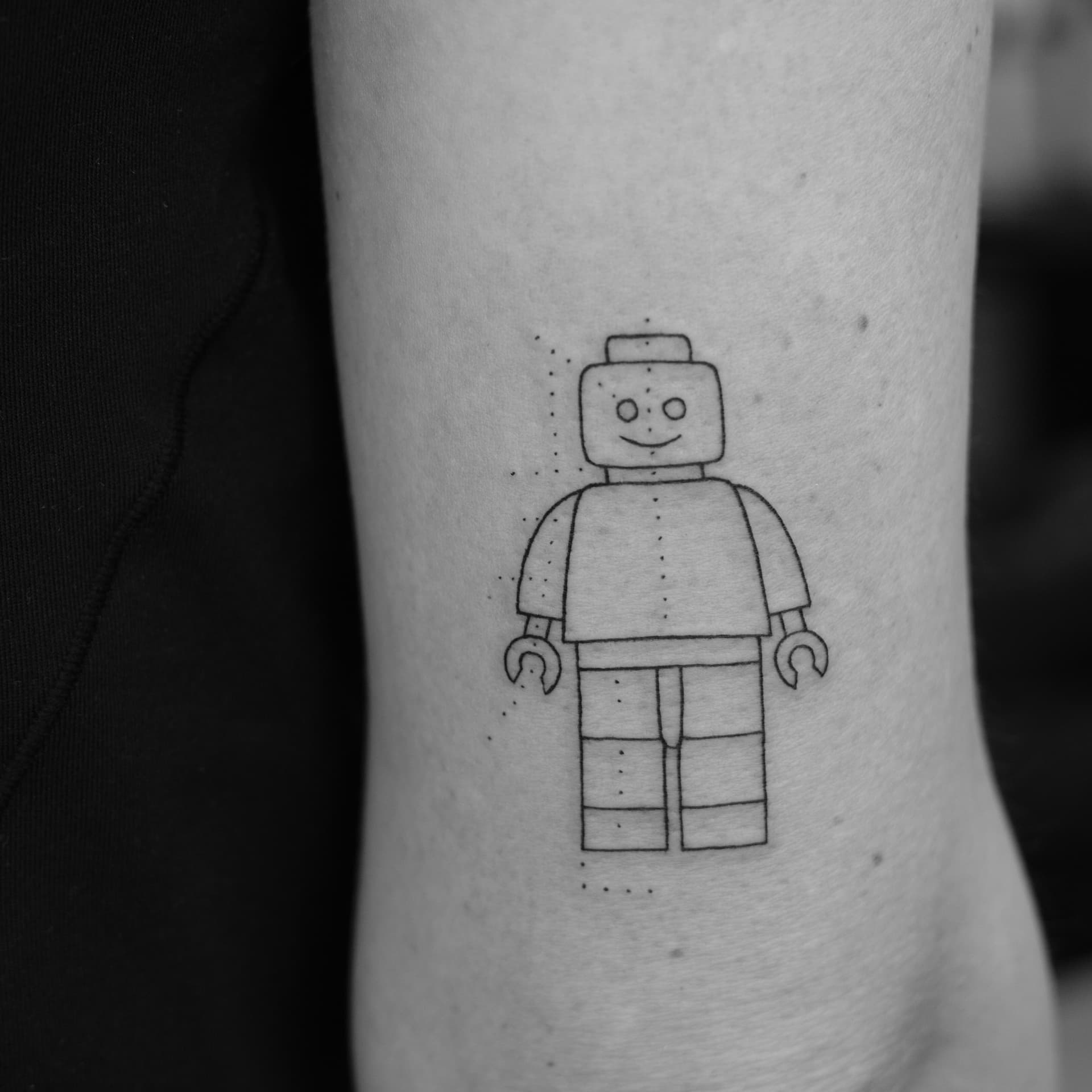
Dragon, samurai and geisha are figures with direction. They need a surface they can unfold on: upper arm, forearm lengthwise, shoulder blade, thigh. On a small area you do not shrink them, you simplify them — a different decision, and I wrote it all down in Small tattoos. Which spots hold up long-term is in the placement guide.
If one of these motifs has been on your mind for a while, write to me and tell me which figure it is and why that one. I prefer that question to a finished Pinterest image. How I work with Japanese tattoos in Munich is on the style page; more motifs are in the motif overview.